

New Fat-Forming Cells Discovered: Why Belly Fat Increases in Middle Age
A new study published in the journal Science has identified a previously unknown population of adipose progenitor cells that emerges during middle age and actively drives the formation of new fat cells. The discovery helps explain why visceral fat tends to accumulate with age and reveals a potential therapeutic target for preventing age-related obesity and metabolic disease.
New Fat-Forming Cells Identified as a Driver of Middle-Age Weight Gain
For many adults, gaining abdominal fat seems almost inevitable with age. While changes in metabolism, hormones, and lifestyle have long been blamed, researchers have now uncovered a surprising biological mechanism that may be directly responsible.
In a groundbreaking study published in the journal Science, scientists discovered a distinct population of fat progenitor cells that appears specifically during middle age and dramatically increases the body's ability to generate new fat cells. The findings offer a new explanation for why visceral fat accumulates as we grow older and may open the door to future therapies targeting age-related obesity.
Fat Growth Is Not Just About Larger Fat Cells
Traditionally, age-related weight gain has been attributed largely to the enlargement of existing fat cells, a process known as hypertrophy. However, the new study shows that another mechanism becomes highly active during middle age: adipogenesis, the creation of entirely new fat cells from adipose progenitor cells (APCs).
Using lineage-tracing techniques in mice, researchers observed that fat-cell turnover remains relatively low during young adulthood. Surprisingly, this changes dramatically in middle age, when visceral fat tissue begins generating large numbers of new adipocytes. In some middle-aged male mice, more than 80% of visceral fat cells were newly formed.
Discovery of an Age-Specific Cell Population
To understand what triggers this, surge in fat formation, the researchers used single-cell RNA sequencing to analyse adipose tissue.
They identified a previously unknown subgroup of progenitor cells called Committed Preadipocytes, Age-Enriched (CP-A). These cells were largely absent in young animals but emerged during middle age and exhibited a remarkable capacity for proliferation and fat-cell formation.
Importantly, when CP-A cells were transplanted into younger animals, they maintained their enhanced fat-forming abilities. This demonstrated that the increased adipogenic potential was an intrinsic property of the cells themselves rather than simply a consequence of the ageing environment.
A Key Molecular Pathway Emerges
The study also identified a critical signalling pathway that controls these age-associated progenitor cells.
Researchers found that CP-A cells rely heavily on signalling through the Leukaemia Inhibitory Factor Receptor (LIFR). When LIFR signalling was blocked using pharmacological or genetic approaches, the ability of CP-A cells to generate new fat cells was dramatically reduced. Visceral fat expansion was also significantly suppressed.
Notably, inhibiting LIFR affected the newly discovered age-specific progenitor cells but had little effect on adipogenesis in younger animals, suggesting that this pathway may provide a highly targeted therapeutic opportunity.
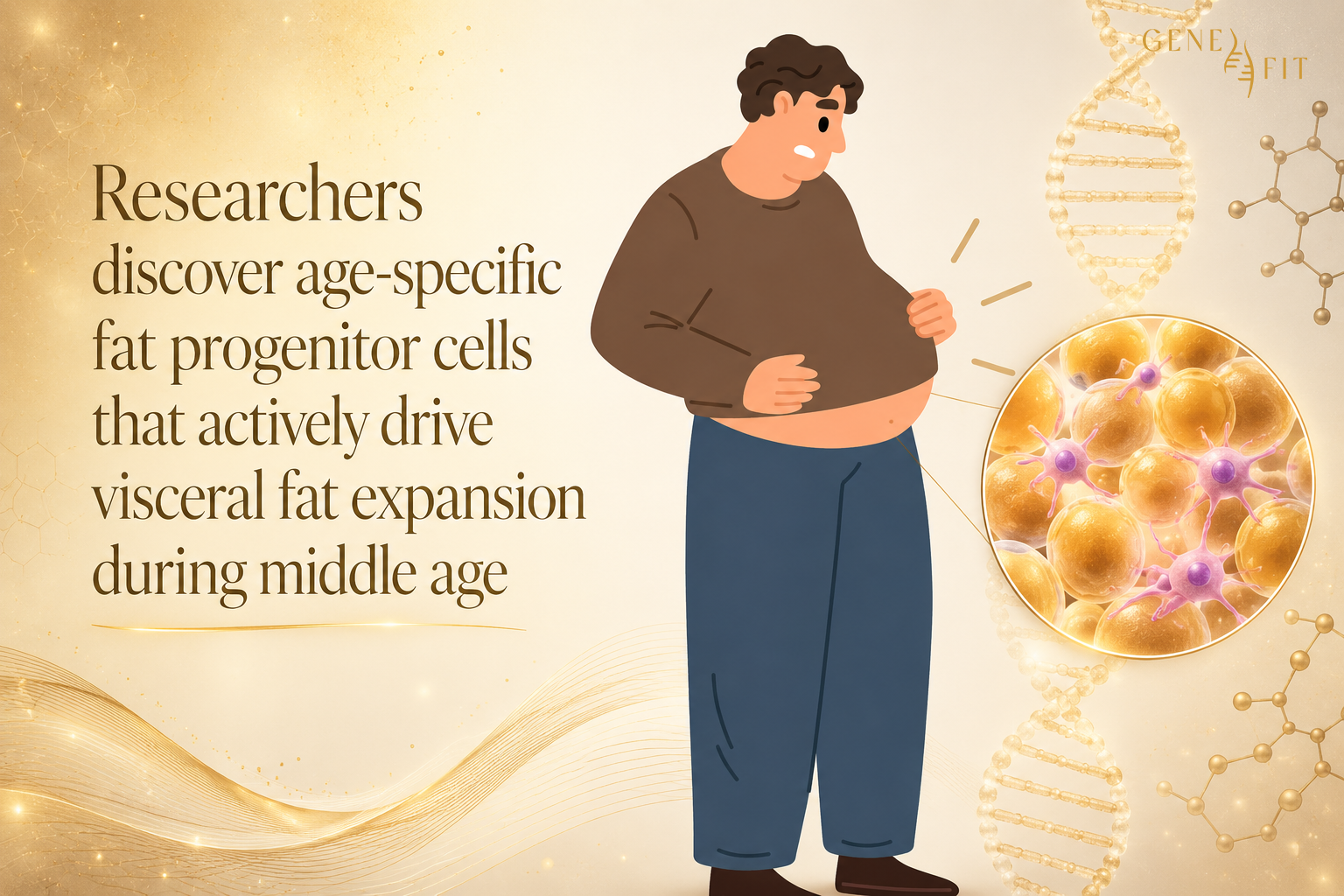
Why This Matters for Metabolic Health
Visceral fat, the fat stored around internal organs, is strongly associated with insulin resistance, type 2 diabetes, cardiovascular disease, and other age-related metabolic disorders.
The discovery that middle age triggers the emergence of specialised fat-producing progenitor cells provides a mechanistic explanation for why abdominal obesity often accelerates despite relatively modest changes in diet or activity levels. It also challenges the long-held assumption that ageing universally reduces stem-cell function. In contrast, these adipose progenitors become more active with age.
Although the study was conducted primarily in mice, researchers also identified similar CP-A-like cell populations in human adipose tissue, suggesting the mechanism may be relevant to human ageing as well.
What Comes Next?
The findings raise exciting possibilities for future interventions aimed at preventing age-related visceral fat accumulation. Targeting LIFR signalling or the newly discovered CP-A cells could slow the development of obesity and metabolic disease with ageing.
However, additional research will be needed to determine whether similar therapeutic strategies can be safely and effectively applied in humans.
Why This Matters for GeneFit Readers
This study highlights an important principle of precision health: age-related weight gain is not simply the result of lifestyle choices or a slowing metabolism. Biological changes within adipose tissue itself can fundamentally alter how the body stores fat.
As GeneFit continues to integrate genetics, lifestyle factors, and biomarker analysis into personalised health strategies, discoveries like these help explain why individuals respond differently to ageing and weight-management interventions. Understanding the cellular mechanisms underlying visceral fat accumulation may eventually support more targeted approaches to obesity prevention, metabolic health optimisation, and healthy ageing.
Reference
Wang, G., Li, G., Song, A., Zhao, Y., Yu, J., Wang, Y., Dai, W., Salas, M., Qin, H., Medrano, L., Dow, J., Li, A., Armstrong, B., Fueger, P. T., Yu, H., Zhu, Y., Shao, M., Wu, X., Jiang, L., Campisi, J., Yang, X., & Wang, Q. A. (2025). Distinct adipose progenitor cells emerging with age drive active adipogenesis. Science, 388(6745), eadj0430. https://doi.org/10.1126/science.adj0430
Disclaimer: The information on this website is for educational purposes only and does not constitute medical advice, diagnosis, or treatment. Content is based on publicly available scientific sources and does not replace consultation with a DHA-licensed healthcare professional. No claims are made that this information can prevent, diagnose, or cure any disease. Individual results may vary. GeneFit Clinics assumes no responsibility for any consequences arising from the use of this information.

Ready to unlock your potential?
Your body deserves better than guesswork.
Book a consultation to discover a personalised transformation experience, built on your unique biology and delivered with concierge-level care.