

Three Servings of Full-Fat Dairy a Day Did Not Cause Weight Gain, Study Finds
A 12-week randomized study of 74 adults with overweight or obesity found that eating three servings of full-fat dairy every day did not increase body weight, body fat, blood glucose, HbA1c, or cholesterol levels. The dairy groups also experienced modest reductions in systolic blood pressure, while protein and calcium intake increased. The findings challenge the simple idea that choosing full-fat dairy automatically leads to weight gain. However, the study was relatively small and lasted only 12 weeks, so longer-term effects remain uncertain.
Full-Fat Dairy May Not Be the Weight-Gain Villain We Thought
For years, people trying to lose weight have often been advised to choose low-fat dairy products. But new research suggests that the relationship between dairy fat, body weight, and metabolic health may be more complicated than simply choosing "low fat" over "full fat."
A randomized 12-week study published in The Journal of Nutrition examined what happened when adults with overweight or obesity added three daily servings of full-fat dairy to their diets. The researchers followed 74 participants with an average age of about 37 years and an average BMI of approximately 29.3.
Participants were divided into three groups. One followed a calorie-restricted diet with limited low-fat dairy. Another replaced the planned 500-calorie restriction with three servings of full-fat dairy. The third consumed three servings of full-fat dairy without a prescribed calorie restriction. All participants received dietary counseling based on Canada's Food Guide.
So, did full-fat dairy lead to weight gain?
Not according to the results.
The researchers found that three daily servings of full-fat dairy did not increase body weight or BMI compared with the energy-restricted, low-dairy group. There were also no significant effects on body fat, fat-free mass, or resting metabolic rate.
In the group consuming full-fat dairy without calorie restriction, hip circumference decreased slightly, while systolic blood pressure fell by approximately 2.7 mmHg over the 12 weeks. Systolic blood pressure also decreased in the calorie-restricted group.
What about cholesterol?
This is another area where the results were reassuring.
The researchers found no significant treatment-related changes in total cholesterol, LDL cholesterol, HDL cholesterol, or non-HDL cholesterol. Triglycerides temporarily increased at week four across the groups but had returned to baseline by week 12.
Blood glucose and HbA1c also remained stable, with no significant differences attributable to the dietary interventions.
Full-fat dairy also improved some nutrient intakes
The benefits were not limited to what did not happen.
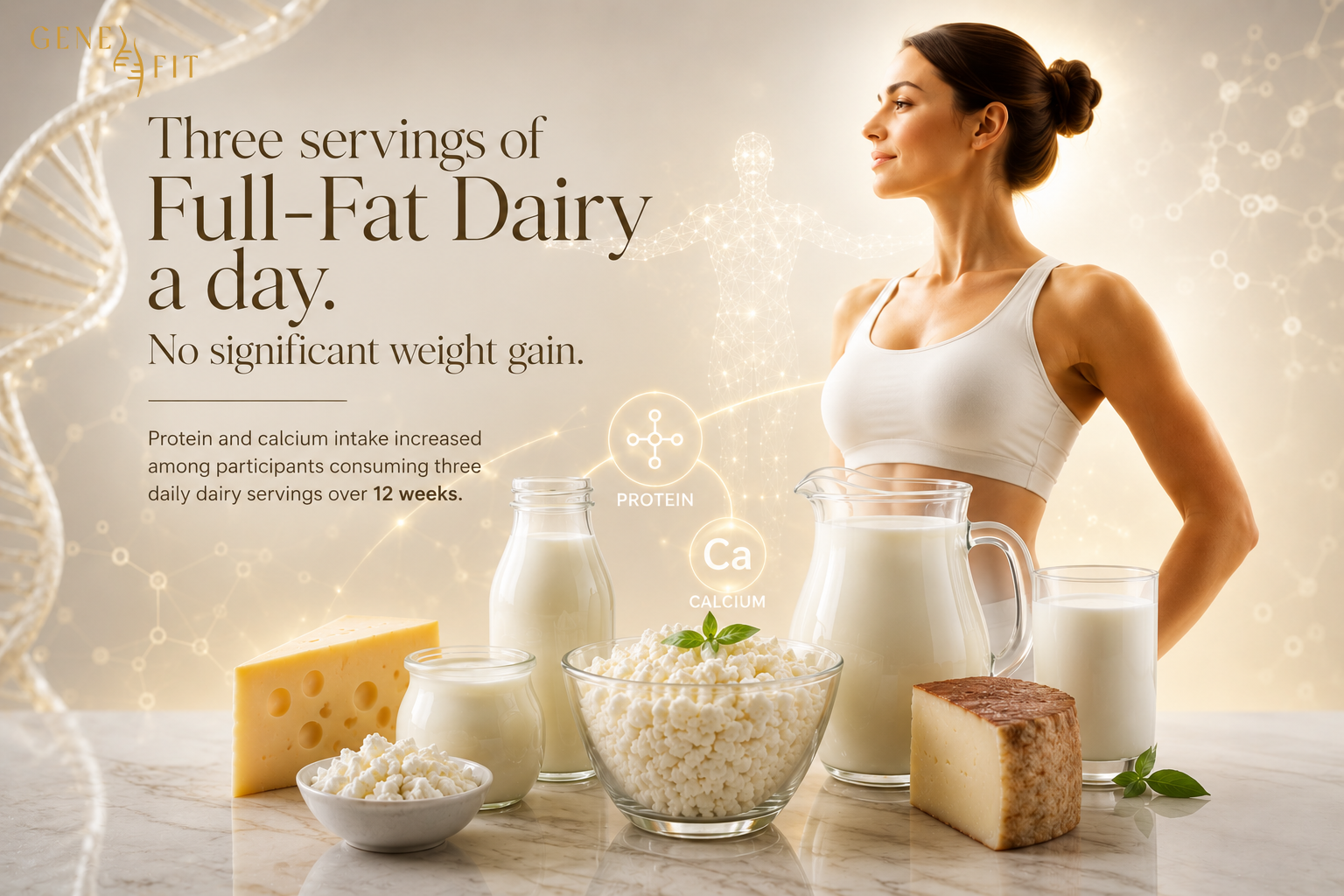
Participants consuming three servings of full-fat dairy increased their intake of protein and calcium, two nutrients that can be important for maintaining muscle and bone health. The intervention was also associated with broader dietary changes, including increased whole-grain consumption and reductions in some processed and confectionery foods.
Importantly, the participants were not simply told to eat more dairy without changing anything else. They received dietary counseling based on Canada's Food Guide, and adherence to the dietary recommendations reached approximately 77% by week 12.
But this does not mean "full-fat dairy is a weight-loss food"
That would be an overinterpretation.
The study showed that three daily servings of full-fat dairy could be incorporated into a healthy diet without producing weight gain over 12 weeks. It did not demonstrate that full-fat dairy causes weight loss or that everyone should consume three servings every day.
The study also had important limitations. Recruitment was affected by COVID-19, the researchers were unable to reach their original target sample size, and the planned longer intervention was shortened. Most importantly, 12 weeks is relatively short when evaluating long-term changes in body composition and cardiometabolic health.
The bigger lesson
The findings highlight a broader issue in nutrition: a food should not necessarily be judged by one nutrient in isolation.
Full-fat dairy contains saturated fat, but it also provides protein, calcium and other nutrients. Its effect within an individual's overall dietary pattern may be different from what we would predict simply by looking at its fat content.
For people interested in body optimisation, this distinction matters.
Instead of asking whether a food is simply "good" or "bad," a more useful question may be:
How does this food fit into my overall diet, energy intake, metabolic profile, activity level, and individual nutritional needs?
That is where personalised nutrition becomes particularly relevant.
Why This Matters for GeneFit Readers
The study reinforces an important principle behind personalized nutrition: there is rarely a single dietary rule that works equally well for everyone.
Three servings of full-fat dairy did not lead to increases in weight, body fat, blood glucose, HbA1c, or cholesterol in this particular group over 12 weeks. But individual responses to dietary fat, dairy, calories, protein, and carbohydrates can vary considerably.
For a precision-health approach, the goal should therefore not be simply to label foods as "low fat" or "high fat." Instead, dietary recommendations can be considered alongside an individual's body composition, metabolic characteristics, nutritional requirements, lifestyle, and potentially genetic profile.
In other words, the question is not only "What does this food contain?"
It is also "What does this food mean for you?"
Key Takeaways
🥛 Three daily servings of full-fat dairy did not cause weight gain over 12 weeks.
⚖️ There were no significant increases in body fat or BMI in the full-fat dairy groups.
❤️ Systolic blood pressure decreased modestly in the full-fat dairy group without calorie restriction.
🧪 Total cholesterol, LDL, HDL, blood glucose and HbA1c were not adversely affected.
💪 Protein and calcium intake increased among participants consuming three daily dairy servings.
📅 The study lasted only 12 weeks, so long-term conclusions require further research.
🧬 Nutrition may be better approached through individual metabolic and nutritional characteristics rather than blanket rules.
Reference
Anderson, G. H., Zhou, C. Z. C., & Vien, S. (2026). The effect of three daily servings of full-fat dairy for 12 weeks on body weight, body composition, energy metabolism, blood lipids, and dietary intake of adults with overweight and obesity. The Journal of Nutrition, 156(4), 101373. https://doi.org/10.1016/j.tjnut.2026.101373
Disclaimer: The information on this website is for educational purposes only and does not constitute medical advice, diagnosis, or treatment. Content is based on publicly available scientific sources and does not replace consultation with a DHA-licensed healthcare professional. No claims are made that this information can prevent, diagnose, or cure any disease. Individual results may vary. GeneFit Clinics assumes no responsibility for any consequences arising from the use of this information.

Ready to unlock your potential?
Your body deserves better than guesswork.
Book a consultation to discover a personalised transformation experience, built on your unique biology and delivered with concierge-level care.